
Water damage rarely stops at what you can see. It weakens structural timber, swells subfloor, ruins insulation and lifts flooring, and most of that sits behind a wall or under a board until somebody opens it up. This page is about the second half of the job: putting the building back once it is properly dry.
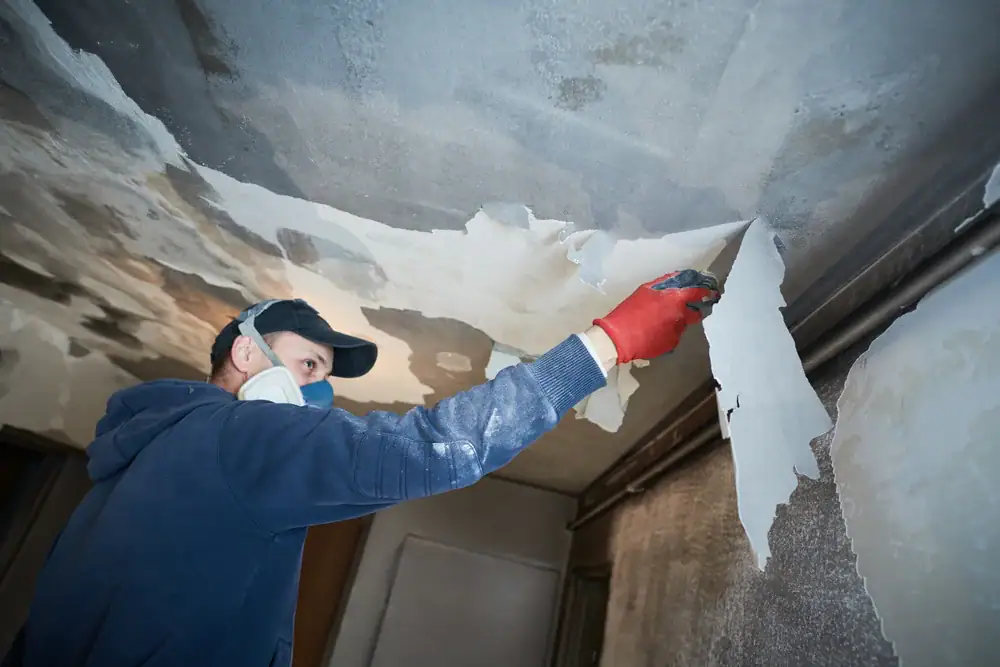
There are two halves to a water loss and they are different trades. The first half is mitigation: pumping out, drying, and stopping the damage spreading. The second half is reconstruction, which is putting the building back. This page is about the second half.
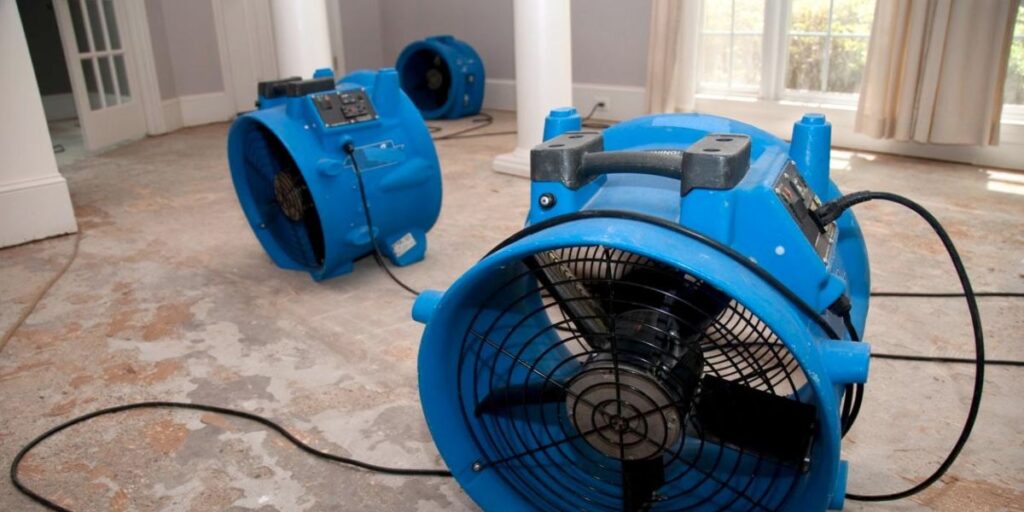
The order is not negotiable. Repairs cannot start until the structure is genuinely dry, measured on a meter rather than judged by hand, because sealing a wet wall behind new drywall traps the moisture and buys you a mold problem in a cavity you can no longer see. Every year somebody calls us to open up a repair that another contractor closed too early.
We do both halves ourselves with one project manager across the whole job. That matters more than it sounds. When mitigation and reconstruction are two different companies, the handoff is where jobs stall: two schedules, two invoices, and each one waiting on the other. It is also where responsibility gets blurry if something was closed up wet.
We have been doing this across Milwaukee County for over 15 years, and our technicians hold IICRC certification, the restoration industry’s training standard.
What has to be replaced rather than dried depends on the material, not on how bad it looks. Some things shed water and recover. Others absorb it, lose their structure, and never come back, and knowing which is which is most of what a fair scope is.
As a rough guide: solid, non-porous materials usually survive. Porous materials that have been saturated usually do not. The three below are the ones that come up on nearly every job.
Drywall wicks water upward from its bottom edge, so the damage sits in a band above the floor rather than at floor level, and the paper facing loses strength once saturated. If it has only been damp briefly it can often be dried in place. If it crumbles, sags, or the seams have opened, it comes out.
The usual approach is a flood cut: removing a clean horizontal band above the water line so the cavity, the insulation and the framing behind it can dry and be inspected. It looks drastic and it is far cheaper than replacing a whole wall later.
Flooring behaves very differently by type. Solid hardwood cups when it takes on water from below and can often be dried and refinished if we get to it fast, using mat systems that pull moisture out through the boards. Engineered wood and laminate are usually a loss, because they are layers bonded with adhesive and once that bond swells it does not go back.
Carpet depends on the water category, not the carpet. Clean water and the carpet can often be saved while the pad underneath is replaced. Contaminated water and both come out.
The subfloor underneath matters more than the surface. It holds water long after the top looks fine, and laying new flooring over a wet subfloor is the most common way a repair fails.
Wet insulation is the item people most often want to leave in, and the one we most consistently take out. Fiberglass and cellulose lose their R-value once saturated and compressed, which means they stop doing the job you are paying to heat your house around, and they do not recover on drying.
They also hold moisture against the framing and sheathing behind them, in a cavity with very little airflow. In a Wisconsin winter that is exactly the condition mold needs. Replacing insulation is cheap relative to opening the wall again in a year.
A good repair is one you cannot find afterwards. That sounds obvious and it is the part most often got wrong, because matching is harder than building.
New drywall has to be taped, floated and textured to match the existing wall, and a texture that is close but not right catches the eye every time the light changes. Paint has to be cut to a sensible break, usually a corner, rather than stopped mid wall where the new and old will never quite agree. Flooring has to be woven into the existing run rather than butted against it in a straight seam.
Where an exact match genuinely is not available, and with discontinued flooring it sometimes is not, we will tell you before the work starts rather than after, and talk through the options. Some policies include matching provisions that help here, and that is a conversation worth having with your adjuster early rather than late.
The repair phase runs in a set order, and each step gates the next.
1. Confirm dry. Final moisture readings across every affected material, compared against unaffected areas of the same property. Nothing gets closed up until those numbers hit target. This reading is recorded, because it is also the proof that the work was done properly.
2. Agree the scope in writing. Every line justified by a photograph and a reading, priced, and sent to you and to your adjuster before anything is ordered. Surprises after this point should be rare, and when something genuinely is hidden behind a wall you hear about it the same day with the reason.
3. Structural and rough work. Framing repairs where needed, then insulation, then drywall hung, taped and finished to match the existing texture.
4. Finishes. Flooring, trim, paint, fixtures reinstalled. This is the longest phase on most jobs and the one where material lead times, not labor, usually set the calendar.
5. Walkthrough. We walk it with you before we close the job, and the punch list gets done before the final invoice, not after it.
If the drying is finished and you are looking at an empty, opened-up room wondering what happens next, that is the point this page exists for. Call 414-519-9912 and we will walk it with you and put a written scope together.
If another company did your mitigation and has handed you off, that is fine and common. Bring us their moisture logs if you have them, and if you do not, we will take our own readings before we close anything up.
Almost never, and this is the most important question on this page. Surfaces dry first and structure dries last. A floor can feel completely dry while the subfloor beneath it and the bottom plate of the wall beside it are still holding a great deal of water.
Before any repair starts we take readings on each affected material and compare them against an unaffected area of the same property, because “dry” is relative to the building rather than a fixed number. Only when those match does anything get closed up.
Closing a wall early is the single most expensive mistake in this trade. The moisture has nowhere to go, the cavity has almost no airflow, and the first sign of trouble is usually a smell or a stain months later, by which point the new drywall you just paid for comes out again.
Often yes, if we get to it quickly. Hardwood that has taken on water from below cups, meaning the board edges rise above the center. Cupping on its own is not a death sentence.
Specialized floor drying systems pull moisture out through the boards rather than just blowing air across the top, which is what gives solid hardwood a real chance. Once the moisture content is back to normal, many floors relax flat again and need only sanding and refinishing rather than replacement.
Two things change that answer. If the floor has been wet long enough to crown, or if the boards have separated at the tongue, replacement is usually the honest call. And engineered wood or laminate is a different product entirely: those are bonded layers, and once the adhesive swells the damage is permanent no matter how fast we arrive.
Because it does not recover. Fiberglass and cellulose insulate by trapping air in their structure. Saturate them and that structure compresses, and when they dry out they stay compressed, so the R-value is permanently reduced. You are then heating a Wisconsin house through insulation that is no longer doing its job, and paying for it every month.
The second reason is where it sits. Insulation lives in a closed cavity against framing and sheathing, with very little airflow to help it dry. Wet material in an unventilated cavity is the textbook condition for mold growth, and it is completely hidden until it is not.
Insulation is also one of the cheaper materials in the wall. Replacing it while the cavity is already open costs a fraction of opening that wall again later.
Sagging, heavy staining, or paint that has started to bubble all mean the same thing: the material is holding water and has lost strength. Water is heavy, roughly eight pounds per gallon, and a ceiling holding a pocket of it can come down without much warning.
If you can see any of those signs, stay out of the room and keep children and pets out. Do not poke it to see how bad it is, which is a very human instinct and a genuinely dangerous one. If the ceiling is below a bathroom or a kitchen, treat it as urgent.
What we do on arrival is find the source, controlled-drain the trapped water rather than letting it find its own way out, then assess whether the ceiling can be dried or has to come down. Insulation above a wet ceiling almost always comes out either way.
That is the goal, and it is worth being honest about where it is easy and where it is not.
Paint and drywall are the easy cases: with the right texture match and a sensible break line at a corner, a finished repair is genuinely invisible. Trim and doors are straightforward too, because profiles are widely available.
Flooring is where matching gets difficult, especially if the existing floor is more than a few years old or the line has been discontinued. Wood also ages: a new board next to a ten year old board will differ in tone even from the same product, though that usually evens out with light over time.
Where we cannot match exactly, you hear it before the work starts, along with the options, which usually run from feathering the repair into a natural break, to replacing a whole run, to a full room. Some policies contain matching provisions worth raising with your adjuster early.
You are the policyholder, but we take the lead on the technical documentation your claim needs. We record the whole repair process, from the initial moisture readings through to the final structural fixes, and work directly with your insurance company so the paperwork does not land on you.
That record is what settles disagreements later. Adjusters approve scopes faster when the evidence is already in the format they use, and you are not the one chasing it.